

Our History
Cutting Edge of Robotics Since 1988
Barrett spun out of the Massachusetts Institute of Technology (MIT) Artificial Intelligence Laboratory (now CSAIL) where Barrett’s founder, Bill Townsend, created the world’s first human-interactive robotic arm, funded by NASA, while earning his PhD. With seed investment from Julianne Barrett and grants from NASA, NSF, NIH, DOE, and DARPA, Barrett developed its groundbreaking Puck® motor technology and innovative gearless drives that power its world-class robots, including the WAM® arm, BarrettHand™, and Burt®.
Indeed the Puck® is now used by hundreds of customers worldwide across an array of applications from humanoids, to medical devices, to consumer products that leverage its advantages, including:
ultra-compactness (10x smaller than the next smallest)
high-performance
excellent power-efficiency
durability
robust control
low electrical noise
smooth torque control
application simplicity (eliminated wires/connectors)
auto-tuning for application to any brushless motor
Our robotic therapy solutions have been in the making since 2007. We have introduced innovative robotic technology throughout the years and are incredibly proud of the advancements we have contributed to the medical community. The launch of Burt® in 2019 is a significant achievement in promoting upper-limb recovery from neurological injuries such as stroke, traumatic brain injury (TBI), spinal cord injury (SBI), Parkinson's, and others.
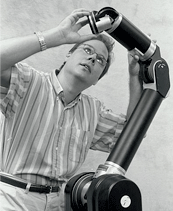
Barrett founder Bill Townsend inspecting a WAM Arm in 1997
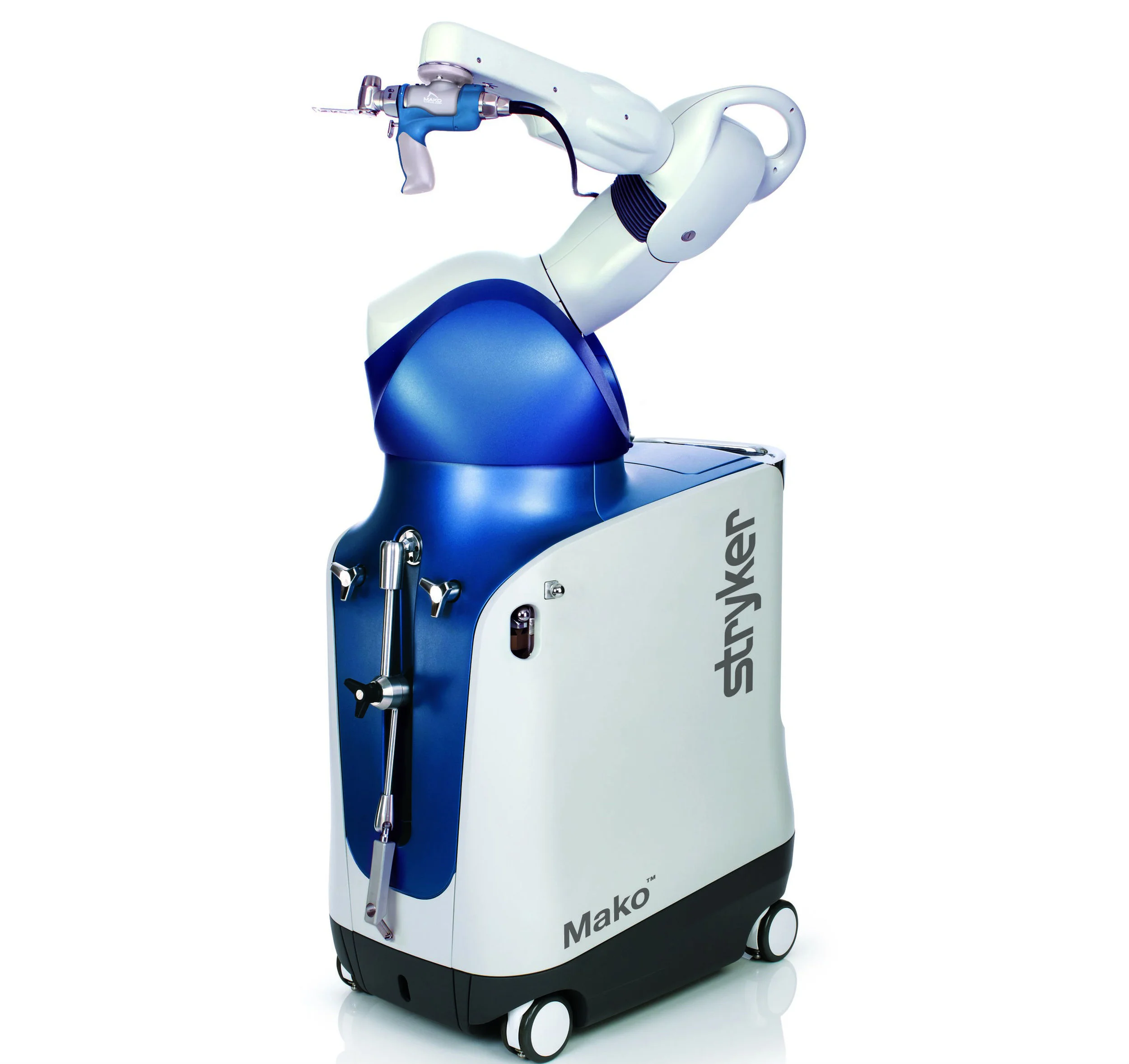
MAKO Surgical licenses Barrett’s WAM® in 1998
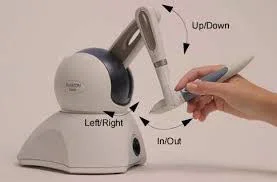
In 1999 Barrett licenses key patent for PhanTom®, the first ever haptic device.

In 2004 Barrett collaborates with the Rehabilitation Institute of Chicago
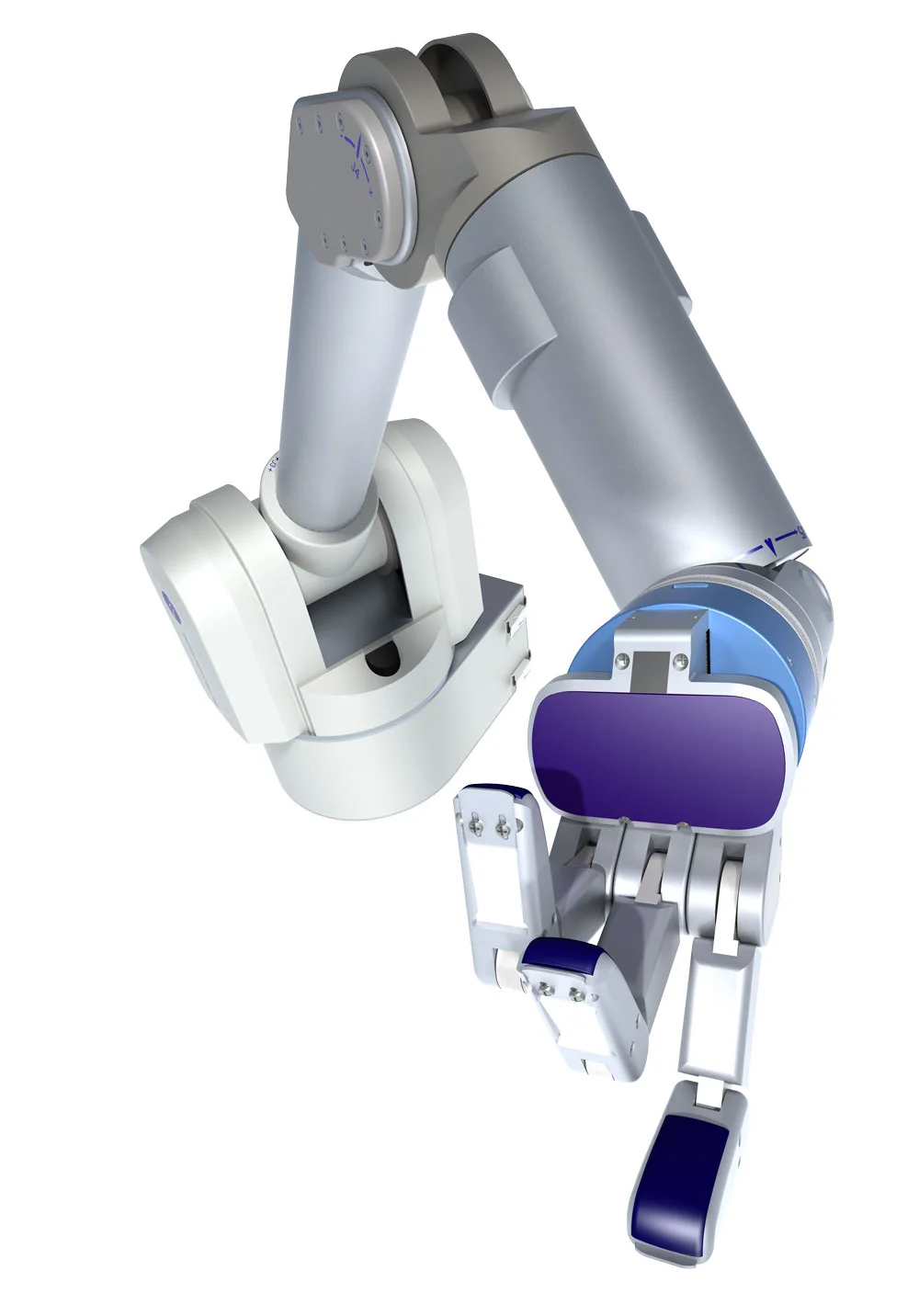
In 2010 Barrett exceeds $40m in worldwide sales of robots.

In 2016 Barrett begins a collaboration with Spaulding Rehabilitation Hospital.
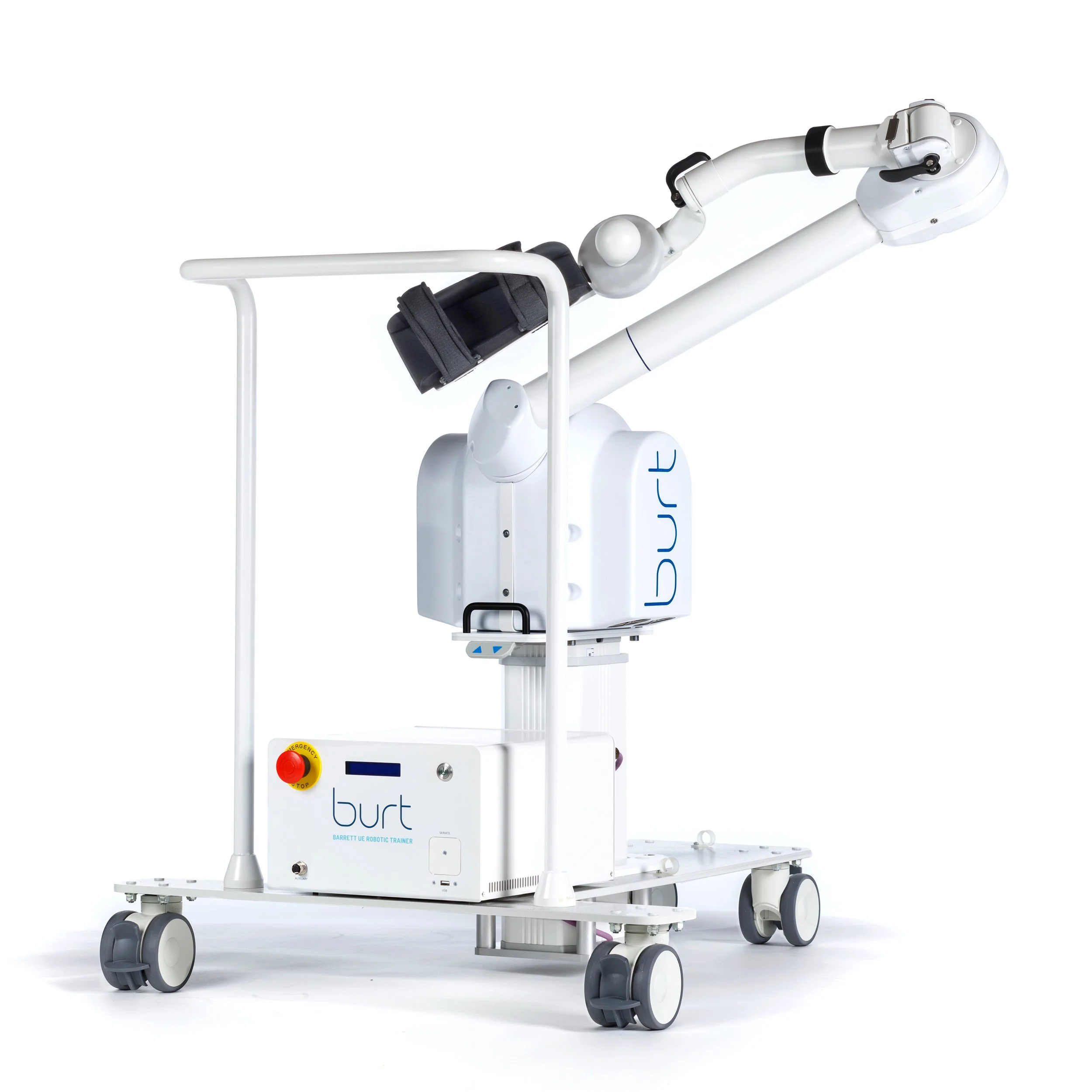
In 2019 Barrett begins its first hospital deployments of Burt®.

In 2021 Barrett begins hospital deployments in China through a joint venture with Estun Automation.
-
1988
Barrett
Starting out as an MIT spinoff, Barrett introduces the first-ever human-interactive robot.
-
1998
WAM®
MAKO Surgical licenses Barrett’s flagship WAM® robot arm for their RIO® surgical robot. (MAKO later purchased by Stryker for $1.6B.)
-
1999
PhanTom®
Barrett licenses key patent to SensAble Technologies for its PhanTom®, the first ever haptic device, a concept that inspired many human-interactive robots like Intuitive Surgical’s DaVinci surgical robot.
-
2000
WAM® most advanced robot
The special Millennium Edition of the Guinness Book of Records cites the WAM® arm as the world’s “most advanced” robot.
-
2004
WAM® modified
Barrett collaborates with the Rehabilitation Institute of Chicago, supported by funding from the National Institutes of Health, to modify a WAM® Arm for error-augmentation neurorehabilitation.
-
2010
$40m in robotic sales
Barrett exceeds $40m in worldwide sales of robots.
-
2011
Burt®
Barrett kicks off development of Burt®, its neurorehabilitation platform robot.
-
2014
Lower-extremity robot
Barrett collaborates with Northeastern to create a lower-extremity robot.
-
2016
Spaulding collaboration
Barrett begins collaboration with Spaulding Rehabilitation Hospital.
-
2019
Burt® Product Launch in the United States
Barrett begins its first hospital deployments of Burt®.
-
2021
Burt® Product Launch in China
Barrett begins hospital deployments in China through a joint venture with Estun Automation.